

Vickers hardness testing is a widely recognized method for assessing the hardness of materials. As a leading supplier of Vickers hardness testers, including models like the Fully Automatic Testing Vickers Hardness Tester, Digital Vickers Hardness Tester with Printer, and Auto Turret Vickers Hardness Tester, I've encountered numerous inquiries about converting Vickers hardness values to other hardness scales. In this blog post, I'll provide a comprehensive guide on how to make these conversions, which can be crucial for various industries such as manufacturing, metallurgy, and materials research.
Understanding Vickers Hardness Testing
Before delving into the conversion process, it's essential to understand how Vickers hardness testing works. The Vickers hardness test involves indenting the material surface with a square-based pyramidal diamond indenter under a specified load. After the load is removed, the size of the indentation is measured, and the Vickers hardness number (HV) is calculated using the formula:
[ HV = 1.8544 \times \frac{F}{d^{2}} ]
where ( F ) is the applied load in kilograms - force (kgf) and ( d ) is the average diagonal length of the indentation in millimeters.
The resulting HV value is a measure of the material's resistance to plastic deformation. Higher HV values indicate harder materials, while lower values suggest softer materials.
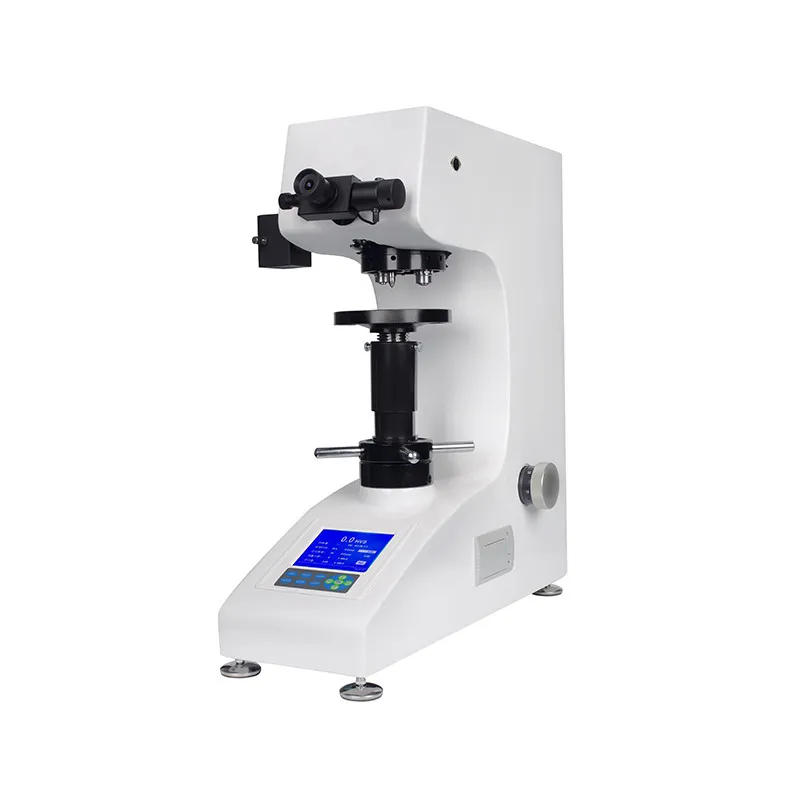

Common Hardness Scales for Conversion
There are several other widely used hardness scales, and the need to convert Vickers hardness values to these scales often arises due to historical data, industry standards, or specific testing requirements. The most common hardness scales for conversion are:
Brinell Hardness (HB)
The Brinell hardness test uses a spherical indenter (usually made of hardened steel or tungsten carbide) to create an indentation on the material surface. The Brinell hardness number (HB) is calculated based on the diameter of the indentation and the applied load.
Rockwell Hardness (HR)
The Rockwell hardness test measures the depth of penetration of an indenter (either a diamond cone or a steel ball) under a minor and a major load. Different Rockwell scales are used depending on the material type and hardness range, denoted by letters such as HRA, HRB, and HRC.
Knoop Hardness (HK)
The Knoop hardness test is similar to the Vickers test but uses a rhombic - based pyramidal indenter. It is often used for testing thin materials or small areas due to the elongated shape of the indentation.
Conversion Methods
Conversion to Brinell Hardness
The conversion from Vickers hardness (HV) to Brinell hardness (HB) is relatively straightforward for most materials, especially for values in the medium - hardness range. A commonly used empirical formula for conversion is:
[ HB \approx HV ]
This approximation holds well for materials with a Vickers hardness up to about 450 HV. For higher hardness values, more complex relationships may be required, and it is advisable to refer to conversion tables or standards. These tables are often based on extensive experimental data and take into account the specific properties of different materials.
Conversion to Rockwell Hardness
Converting Vickers hardness to Rockwell hardness is more complicated because different Rockwell scales are used for different hardness ranges.
- Conversion to HRC (Rockwell C scale): For materials in the high - hardness range (typically above 20 HRC), the following approximate conversion formula can be used:
[ HRC\approx HV/10 - 3 ]
However, this formula is only a rough estimate, and for more accurate conversions, conversion tables are recommended. These tables are based on experimental data for a wide range of materials, including steels, tool steels, and alloys.
- Conversion to HRB (Rockwell B scale): For materials in the lower - hardness range suitable for the HRB scale, the conversion is more challenging and usually requires the use of detailed conversion tables. There is no simple algebraic formula that can accurately cover all materials and hardness values within the HRB range.
Conversion to Knoop Hardness
The relationship between Vickers hardness (HV) and Knoop hardness (HK) is relatively simple, especially for isotropic materials. The conversion formula is:
[ HK\approx 0.96HV ]
This formula assumes that the material has uniform mechanical properties in all directions. In practice, the difference between HV and HK values is usually small, and the 0.96 factor provides a reasonable approximation.
Factors Affecting Conversion Accuracy
It's important to note that the conversion between hardness scales is not always exact, and several factors can affect the accuracy of the conversion:
- Material Composition: Different materials have different microstructures and mechanical properties, which can influence the relationship between hardness scales. For example, the conversion between Vickers and Rockwell hardness may vary for different types of steel, such as carbon steel, stainless steel, and alloy steel.
- Testing Conditions: The load, indenter geometry, and testing environment can all affect the hardness measurement. For accurate conversions, it is crucial to ensure that the testing conditions for both the Vickers and the target hardness scale are consistent with the data used in the conversion formulas or tables.
- Hardness Range: The accuracy of the conversion formulas may vary depending on the hardness range. Some formulas are more accurate for low - hardness materials, while others are better suited for high - hardness materials.
Using Conversion Tables and Standards
To obtain the most accurate conversions, it is recommended to use conversion tables and standards provided by organizations such as the International Organization for Standardization (ISO) and the American Society for Testing and Materials (ASTM). These tables are based on extensive experimental data and are regularly updated to reflect the latest research in materials science.
When using conversion tables, it is important to select the appropriate table based on the material type and the hardness range. For example, there are separate conversion tables for steels, non - ferrous metals, and plastics.
Importance of Accurate Hardness Conversion
Accurate hardness conversion is crucial in many industries. In manufacturing, it ensures that the material properties meet the design requirements. For example, in the automotive industry, the hardness of engine components is carefully controlled to ensure proper performance and durability. If the hardness values are not accurately converted, it may lead to incorrect material selection or improper processing, resulting in component failure.
In materials research, hardness conversion allows researchers to compare data from different studies and experiments. This is particularly important when studying the effects of heat treatment, alloying elements, and manufacturing processes on material hardness.
Conclusion
Converting Vickers hardness values to other hardness scales is a common requirement in many industries. While there are some approximate conversion formulas, the use of conversion tables and standards is recommended for the most accurate results. As a supplier of high - quality Vickers hardness testers, we understand the importance of accurate hardness testing and conversion. Our products, such as the Fully Automatic Testing Vickers Hardness Tester, Digital Vickers Hardness Tester with Printer, and Auto Turret Vickers Hardness Tester, are designed to provide precise and reliable hardness measurements.
If you are in need of a Vickers hardness tester or have any questions about hardness testing and conversion, please feel free to contact us. We are committed to providing you with the best solutions for your hardness testing needs.
References
- ISO 18265:2013, Metallic materials — Conversion of hardness values.
- ASTM E140 - 12, Standard Hardness Conversion Tables for Metals.