

As a supplier of shore hardness testers, I often encounter inquiries from customers about the suitability of our products for measuring the hardness of foams. This topic is not only relevant to our business but also of great interest to those in industries that use foams, such as packaging, automotive, and furniture manufacturing. In this blog post, I will delve into the question: Can a shore hardness tester measure the hardness of foams?
Understanding Shore Hardness Testing
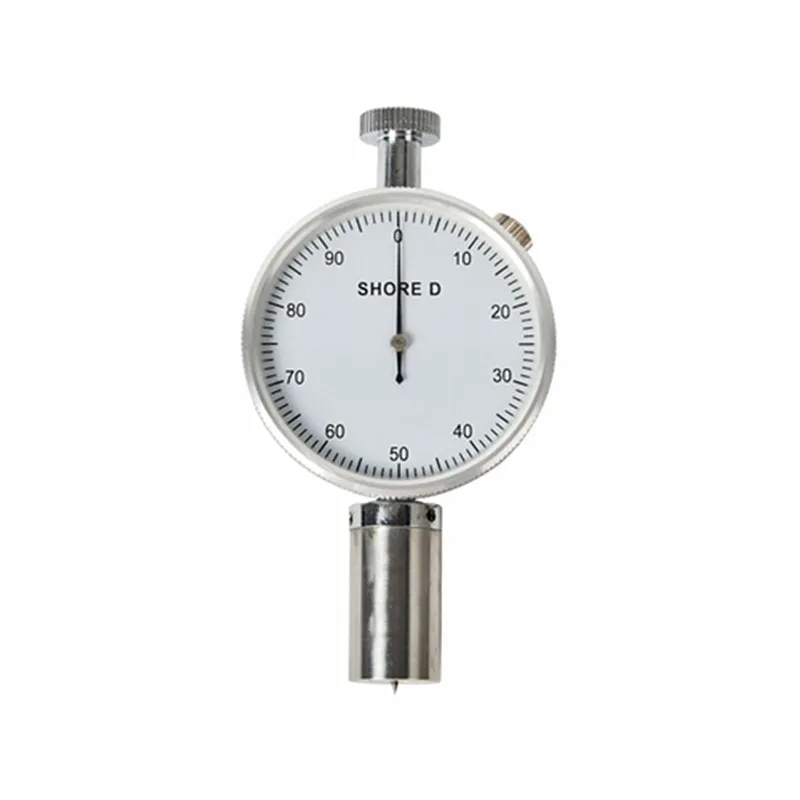
Before we discuss the applicability of shore hardness testers to foams, it's essential to understand what shore hardness testing is. Shore hardness is a measure of the resistance of a material to indentation. It is determined by pressing a specific indenter into the material under a defined force and measuring the depth of the indentation. There are different scales of shore hardness, with the most common being Shore A and Shore D. The Shore A scale is used for softer materials, while the Shore D scale is for harder ones.
We offer a range of shore hardness testers, including the Shore D Digital Hardness Tester, Shore A Digital Hardness Tester, and Dial Shore Hardness Tester for Plastics. These testers are designed to provide accurate and reliable hardness measurements for various materials.
Characteristics of Foams
Foams are porous materials composed of gas bubbles trapped within a solid or liquid matrix. They come in a wide range of densities, cell structures, and chemical compositions, which result in different mechanical properties, including hardness. The hardness of a foam can be influenced by factors such as the type of polymer used, the blowing agent, the density of the foam, and the cell size and distribution.
Can a Shore Hardness Tester Measure the Hardness of Foams?
The answer is yes, but with some limitations. Shore hardness testers can be used to measure the hardness of certain types of foams, especially those with a relatively high density and a more solid-like behavior. However, they may not be suitable for all foams, particularly those that are very soft, highly elastic, or have an open-cell structure.
Suitable Foams for Shore Hardness Testing
- Closed-Cell Foams: Closed-cell foams have a structure where the gas bubbles are isolated from each other by a solid polymer matrix. These foams tend to be more rigid and less compressible than open-cell foams, making them more suitable for shore hardness testing. For example, some closed-cell polyethylene foams used in packaging applications can be tested using a Shore A hardness tester.
- High-Density Foams: High-density foams have a greater amount of solid material per unit volume, which gives them a higher resistance to indentation. They can often be measured using shore hardness testers, although the appropriate scale (Shore A or Shore D) will depend on the specific density and hardness of the foam.
Limitations of Using Shore Hardness Testers for Foams
- Soft and Highly Elastic Foams: Soft and highly elastic foams, such as memory foams or some low-density polyurethane foams, can pose challenges for shore hardness testing. These foams may deform significantly under the indenter, and the indentation may not be fully recovered, leading to inaccurate hardness measurements. In addition, the time-dependent behavior of these foams, known as viscoelasticity, can also affect the measurement results.
- Open-Cell Foams: Open-cell foams have a structure where the gas bubbles are interconnected, allowing air or other fluids to flow through the foam. This open structure makes the foam more compressible and less resistant to indentation, and the indenter may sink into the foam cells, resulting in unreliable hardness measurements.
Considerations for Measuring Foam Hardness
If you decide to use a shore hardness tester to measure the hardness of foams, there are several factors to consider to ensure accurate and reliable results:

- Sample Preparation: The foam sample should be flat, smooth, and of sufficient thickness to avoid any influence from the underlying surface. It is also important to ensure that the sample is free from any defects or irregularities that could affect the hardness measurement.
- Testing Conditions: The testing temperature and humidity can have an impact on the hardness of foams. It is recommended to conduct the tests under controlled environmental conditions to minimize the effects of temperature and humidity variations.
- Indenter Selection: The choice of indenter depends on the hardness of the foam. For softer foams, a Shore A indenter is usually more appropriate, while a Shore D indenter may be used for harder foams. It is important to use the correct indenter to obtain accurate hardness measurements.
- Measurement Technique: The indenter should be applied to the foam sample perpendicular to the surface with a consistent force and for a specified period of time. The depth of the indentation should be measured at the end of the specified time to ensure reproducible results.
Alternative Methods for Measuring Foam Hardness
In addition to shore hardness testing, there are other methods available for measuring the hardness of foams, such as the indentation force deflection (IFD) test and the compression set test.
- Indentation Force Deflection (IFD) Test: The IFD test measures the force required to indent a foam sample to a specified depth. It is commonly used to evaluate the comfort and support properties of foams used in seating and bedding applications.
- Compression Set Test: The compression set test measures the permanent deformation of a foam sample after it has been compressed for a specified period of time. It is used to assess the durability and resilience of foams.
Conclusion
In conclusion, a shore hardness tester can be used to measure the hardness of certain types of foams, but it has its limitations. It is important to consider the characteristics of the foam, such as its density, cell structure, and elasticity, when deciding whether to use a shore hardness tester for hardness measurement. If you have any questions or need further assistance in selecting the appropriate hardness testing method for your foam applications, please feel free to contact us. We are a leading supplier of shore hardness testers and can provide you with professional advice and high-quality testing equipment.
If you are interested in purchasing our shore hardness testers or discussing your specific requirements, please don't hesitate to get in touch. Our team of experts is ready to assist you with your procurement needs and ensure that you get the right product for your application.
References
- ASTM D2240 - Standard Test Method for Rubber Property - Durometer Hardness.
- ISO 868 - Plastics and ebonite - Determination of indentation hardness by means of a durometer (Shore hardness).
- ASTM D3574 - Standard Test Methods for Flexible Cellular Materials - Polyurethane Foams.