

Yo! I'm a supplier of Vickers hardness testers. One question that often pops up from our customers is, "How fast can an automatic Vickers hardness tester perform a test?" Well, let's dig into this topic and find out.
First off, what's a Vickers hardness tester anyway? It's a device used to measure the hardness of materials. The Vickers hardness test involves pressing a square - based diamond pyramid indenter into the material under a specific load. After the load is removed, the size of the indentation left on the material's surface is measured, and from that measurement, the hardness value is calculated.
Now, let's talk about automatic Vickers hardness testers. These bad boys are different from their manual counterparts. In a manual Vickers hardness tester, the operator has to do a lot of work, like positioning the sample, setting the load, measuring the indentation with a microscope, and then calculating the hardness value. This can be pretty time - consuming, especially for a large number of samples.
But automatic Vickers hardness testers take care of a lot of these steps on their own. They can automatically position the sample, apply the right load, measure the indentation using advanced imaging systems, and calculate the hardness value in a jiffy.
The speed of an automatic Vickers hardness test can vary depending on several factors. One of the main factors is the type of sample. If the sample is a simple, homogeneous material like steel with a smooth surface, the tester can perform the test relatively quickly. The auto - positioning feature can accurately place the indenter on the sample in a matter of seconds. The load application time is usually pre - set and can range from a few seconds to a minute, depending on the material's properties and the required accuracy of the test.
For example, if we're testing a regular steel sample, the load application might take around 10 - 15 seconds. After the load is removed, the imaging system of the automatic tester will start to analyze the indentation. Modern automatic testers use high - resolution cameras and sophisticated software to measure the indentation dimensions. This process can take anywhere from 5 to 15 seconds. Once the measurement is done, the software calculates the hardness value in an instant. Overall, for a simple steel sample, an automatic Vickers hardness test can be completed in less than a minute.
However, things get a bit more complex when dealing with non - homogeneous materials. Take a composite material for example. Composites have different phases, fibers, or particles in them. The hardness can vary greatly from one area to another. In this case, the automatic tester might need to take multiple measurements at different locations on the sample. The auto - positioning system will have to move the sample to different test points, and each test point will require the entire load - application, indentation - measurement, and hardness - calculation process. So, for a composite material, the testing time can increase significantly. It might take anywhere from a few minutes to 10 - 15 minutes per sample, depending on the number of test points and the material's complexity.
The accuracy requirements also play a role in the testing speed. If a very high level of accuracy is needed, the tester might slow down the load - application process to ensure that the indentation is formed properly. Also, the imaging system might take more time to measure the indentation with greater precision. So, highly accurate tests will generally take longer.
Now, let's talk about our product range. We offer a variety of Vickers hardness testers to meet different needs. Check out our Digital Vickers Hardness Tester with Printer. This tester combines the convenience of digital technology with the ability to print out test results right on the spot. It's a great choice for those who need quick and reliable hardness testing with the added benefit of having a hard copy of the results.
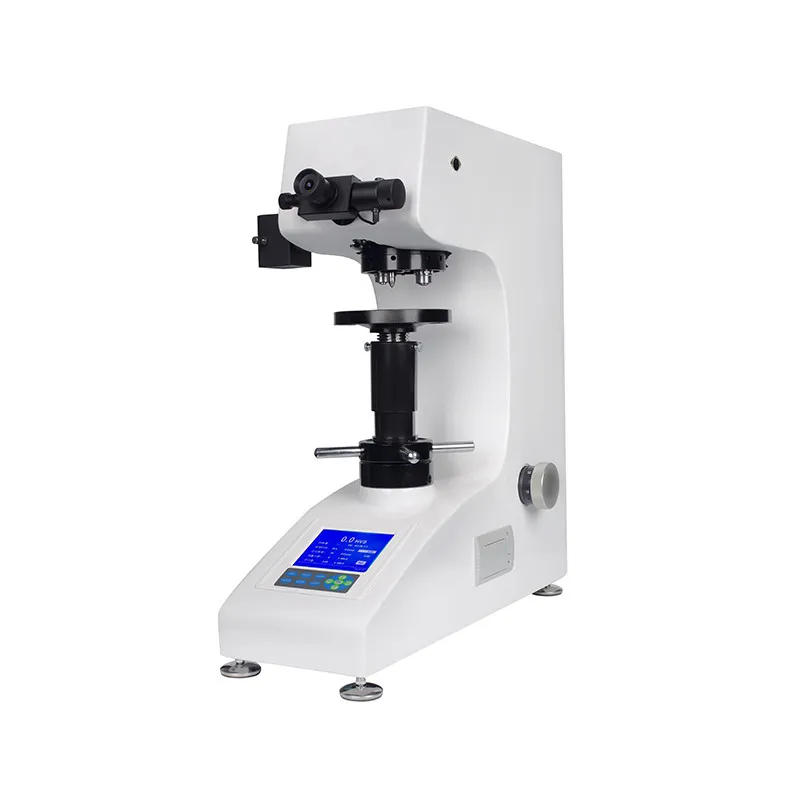

Another great option is our Touch Screen Vickers Hardness with USB Output. The touch - screen interface makes it super easy to operate, and the USB output allows you to transfer the test data to a computer for further analysis. This can save you a lot of time, especially if you need to process a large amount of data.
If you're looking for the ultimate in speed and automation, our Fully Automatic Testing Vickers Hardness Tester is the way to go. This tester can handle a large number of samples with minimal operator intervention. It can perform multiple tests in a row, adjusting the test parameters automatically based on the sample type.
In conclusion, the speed of an automatic Vickers hardness test can range from under a minute for simple, homogeneous materials to several minutes for complex, non - homogeneous materials. The type of tester you choose and the specific requirements of your testing can also have a big impact on the testing speed.
If you're in the market for a Vickers hardness tester and want to learn more about our products, or you have questions about how fast a test can be performed for your specific application, don't hesitate to reach out. We'd be more than happy to have a chat and help you find the perfect solution for your hardness - testing needs.
References:
- ASTM E92 - 17: Standard Test Method for Vickers Hardness of Metallic Materials.
- ISO 6507 - 1:2018: Metallic materials — Vickers hardness test — Part 1: Test method.