

Hardness testing is a fundamental aspect of materials science and engineering, used to evaluate the resistance of a material to deformation. Among the various hardness testing methods available, the Vickers and Rockwell hardness testers are two of the most widely used. As a supplier of Vickers hardness testers, I often encounter questions about the differences between these two types of testers. In this blog post, I will delve into the details of both testers, highlighting their unique features, applications, and advantages.
Vickers Hardness Tester
The Vickers hardness test, developed in 1921 by Robert L. Smith and George E. Sandland at Vickers Ltd, is a microhardness test method. It uses a square-based pyramid-shaped indenter with a 136-degree angle between opposite faces. The indenter is pressed into the test material under a specific load for a defined period, typically 10 to 15 seconds. After the load is removed, the size of the indentation left on the material's surface is measured using a microscope. The Vickers hardness number (HV) is then calculated based on the applied load and the surface area of the indentation.
One of the key advantages of the Vickers hardness test is its ability to provide highly accurate and precise results across a wide range of materials, from very soft to extremely hard. This is because the Vickers indenter's geometric shape allows for a more uniform distribution of stress, reducing the influence of material inhomogeneities. Additionally, the Vickers test can be used on small or thin samples, as well as on materials with irregular surfaces, due to its small indentation size.
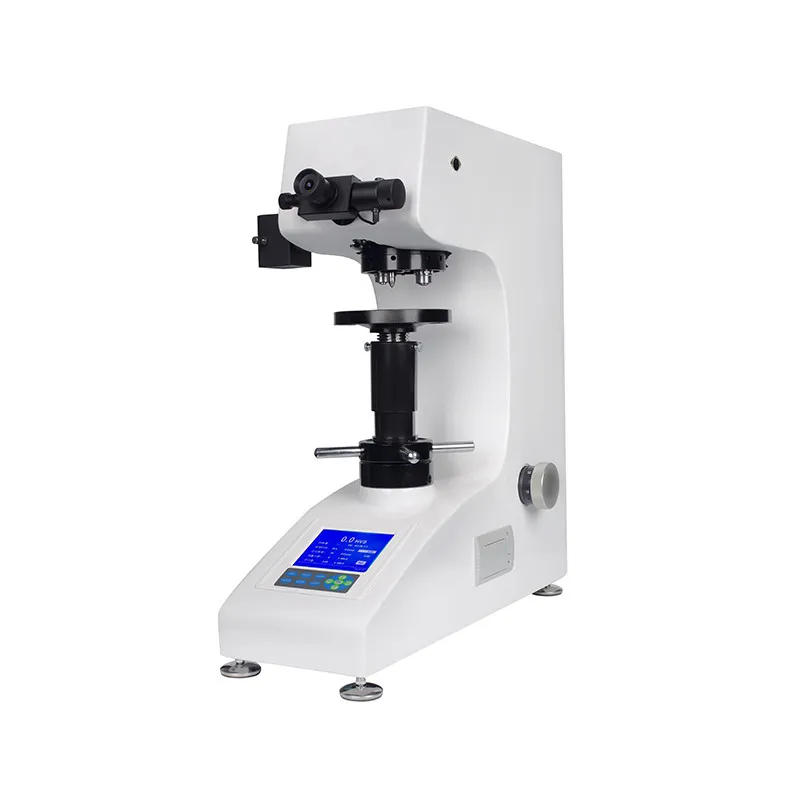
At our company, we offer a variety of Vickers hardness testers to meet different testing requirements. For example, our Closed-loop Electric Sensor Vickers Hardness Tester features a closed-loop electric sensor system that ensures accurate and stable load application, while our Digital Vickers Hardness Tester with Printer allows for easy measurement and printing of test results. We also have a Fully Automatic Testing Vickers Hardness Tester, which can perform multiple tests automatically, improving testing efficiency.
Rockwell Hardness Tester
The Rockwell hardness test, invented by Stanley P. Rockwell and Hugh M. Rockwell in 1919, is a macrohardness test method. It uses a conical diamond indenter (for hard materials) or a hardened steel ball indenter (for softer materials). The test involves two steps: first, a minor load is applied to the material to set the indenter in place, and then a major load is added on top of the minor load for a short period. After the major load is removed, the depth of the indentation left on the material's surface is measured using a dial or digital indicator. The Rockwell hardness number is determined based on the difference in indentation depth before and after the application of the major load.
The Rockwell hardness test is known for its simplicity, speed, and ease of use. It can provide quick results without the need for complex calculations or microscopic measurements. This makes it particularly suitable for high-volume production testing, where rapid and efficient hardness assessment is required. Additionally, the Rockwell test can be performed directly on large or heavy workpieces without the need for sample preparation, as long as the surface is relatively flat.
However, the Rockwell hardness test has some limitations. It is less accurate than the Vickers test, especially for materials with small grain sizes or inhomogeneous structures, as the larger indentation size of the Rockwell test can be more affected by local variations in the material. Also, the Rockwell test is not suitable for very thin or small samples, as the indentation may be too large and cause damage to the sample.
Key Differences
- Indenter Shape and Size: The Vickers indenter is a square-based pyramid, while the Rockwell indenter is either a conical diamond or a steel ball. The Vickers indenter produces a smaller indentation, which allows for more precise testing of small or thin samples and materials with fine microstructures. In contrast, the Rockwell indenter creates a larger indentation, which is more suitable for testing large workpieces and provides an average hardness value over a larger area.
- Load Application and Measurement: The Vickers test applies a single load for a specific time and measures the size of the indentation, while the Rockwell test applies a minor load followed by a major load and measures the change in indentation depth. The Vickers test requires a microscope for indentation measurement, which can be time-consuming but provides highly accurate results. The Rockwell test, on the other hand, uses a direct depth measurement system, which is faster and more convenient but may be less accurate.
- Testing Range: The Vickers hardness test can be used to measure a wide range of hardness values, from very soft to extremely hard materials. The Rockwell test is typically divided into different scales, each with a specific range of hardness values. For example, the Rockwell C scale is used for hard materials, while the Rockwell B scale is used for softer materials. This means that the appropriate Rockwell scale needs to be selected based on the estimated hardness of the material, which can be a limitation in some cases.
- Sample Requirements: The Vickers test can be performed on samples with irregular surfaces and small dimensions, as long as the surface can be polished to a smooth finish. The Rockwell test requires a relatively flat and smooth surface, and the sample needs to be thick enough to withstand the indentation without deformation.
Applications
The choice between a Vickers and a Rockwell hardness tester depends on the specific application and requirements. The Vickers hardness test is commonly used in research and development, quality control, and materials characterization, where high accuracy and precision are essential. It is particularly suitable for testing thin films, coatings, small components, and materials with complex microstructures. For example, in the semiconductor industry, the Vickers test is used to measure the hardness of silicon wafers and thin-film materials.
The Rockwell hardness test, on the other hand, is widely used in manufacturing and production environments, where speed and efficiency are crucial. It is commonly used for testing large metal parts, such as automotive components, aerospace parts, and structural steel. The Rockwell test is also used in the heat treatment industry to monitor the hardness of materials during the heat treatment process.

Conclusion
In summary, both the Vickers and Rockwell hardness testers are valuable tools for hardness testing, each with its own unique advantages and limitations. The Vickers hardness tester offers high accuracy, precision, and versatility, making it suitable for a wide range of materials and applications. The Rockwell hardness tester, on the other hand, provides quick and convenient results, making it ideal for high-volume production testing.
As a supplier of Vickers hardness testers, we are committed to providing our customers with high-quality testing equipment and excellent customer service. If you are interested in learning more about our Vickers hardness testers or need assistance in choosing the right tester for your application, please do not hesitate to contact us. We look forward to discussing your requirements and helping you find the best solution for your hardness testing needs.
References
- ASTM E92 - 17: Standard Test Method for Vickers Hardness of Metallic Materials
- ASTM E18 - 20: Standard Test Methods for Rockwell Hardness and Rockwell Superficial Hardness of Metallic Materials
- Callister, W. D., & Rethwisch, D. G. (2016). Materials Science and Engineering: An Introduction. Wiley.