

Hey there! As a supplier of universal hardness testers, I've seen firsthand how the shape of the indenter can have a huge impact on test results. In this blog post, I'm gonna break down the influence of indenter shape on the test results of a universal hardness tester, and why it matters for your testing needs.
Let's start by talking about what a universal hardness tester is. It's a versatile piece of equipment that can measure the hardness of a material using different testing methods, like Brinell, Vickers, and Rockwell. Each of these methods uses a different indenter shape, and that's where things start to get interesting.
Brinell Indenter
The Brinell indenter is a spherical ball, usually made of hardened steel or carbide. When you use a Brinell hardness test, the indenter is pressed into the material with a specific load for a set amount of time. The size of the indentation left on the material is then measured, and this measurement is used to calculate the Brinell hardness number (BHN).
The spherical shape of the Brinell indenter distributes the load over a relatively large area of the material. This makes it great for testing materials with a coarse or heterogeneous structure, like cast iron or forged steel. The large indentation also means that the test is less sensitive to small surface irregularities. However, because the indentation is so large, it can be a bit destructive to the material, and it might not be suitable for thin or delicate samples.
If you're interested in a hardness tester that can perform Brinell tests, check out our Brinell Vickers Rockwell Hardness Tester. It's a top - notch machine that can handle all these different testing methods with ease.
Vickers Indenter
The Vickers indenter is a square - based pyramid with an included angle of 136 degrees. When conducting a Vickers hardness test, the indenter is pressed into the material under a specific load, and the diagonal lengths of the square indentation are measured. These measurements are then used to calculate the Vickers hardness number (HV).
The pyramid shape of the Vickers indenter allows for a more precise measurement of hardness. It can be used on a wide range of materials, from very soft to very hard. The small size of the indentation makes it less destructive than the Brinell test, so it's great for thin materials or samples where you don't want to cause too much damage. However, the Vickers test is more sensitive to surface finish and small irregularities, so the sample needs to be carefully prepared.
Rockwell Indenter
The Rockwell hardness test uses two types of indenters: a diamond cone (for the Rockwell C scale, used for harder materials) and a steel ball (for the Rockwell B scale, used for softer materials). In a Rockwell test, the indenter is first applied with a minor load to set the initial position, and then a major load is added for a short period. The difference in depth between the initial and final indentations is measured and used to calculate the Rockwell hardness number.
The conical shape of the diamond indenter in the Rockwell C test is ideal for measuring the hardness of extremely hard materials, like hardened steels. The steel ball indenter in the Rockwell B test is better for softer materials, as it distributes the load over a larger area. One of the big advantages of the Rockwell test is its speed. It can provide a hardness reading very quickly, which is great for high - volume testing. But like the Vickers test, it can be affected by surface conditions.
Impact on Test Results
The shape of the indenter affects the test results in several ways. First, the size and shape of the indentation determine how the load is distributed in the material. A larger indenter, like the Brinell ball, spreads the load over a wider area, which can give a different hardness value compared to a smaller indenter like the Vickers pyramid.
Second, the indenter shape can influence the sensitivity of the test to material properties. For example, the Vickers test, with its small and precise indentation, can detect small changes in hardness within a material, while the Brinell test might average out these variations due to its larger indentation.
Third, the indenter shape can impact the suitability of the test for different types of materials. As we've seen, the Brinell test is good for coarse - grained materials, the Vickers test works well for a wide range of materials, and the Rockwell test is great for quick and efficient testing of both hard and soft materials.
Choosing the Right Indenter Shape
When choosing an indenter shape for your hardness testing, you need to consider several factors. First, think about the type of material you're testing. If it's a coarse - grained or heterogeneous material, the Brinell indenter might be a good choice. For thin or delicate materials, the Vickers indenter could be better. And if you need to do high - volume testing quickly, the Rockwell indenter might be the way to go.
You also need to consider the level of precision you need. If you need a very accurate measurement, the Vickers test might be more suitable, but if you're looking for a quick and rough estimate, the Rockwell test could work.
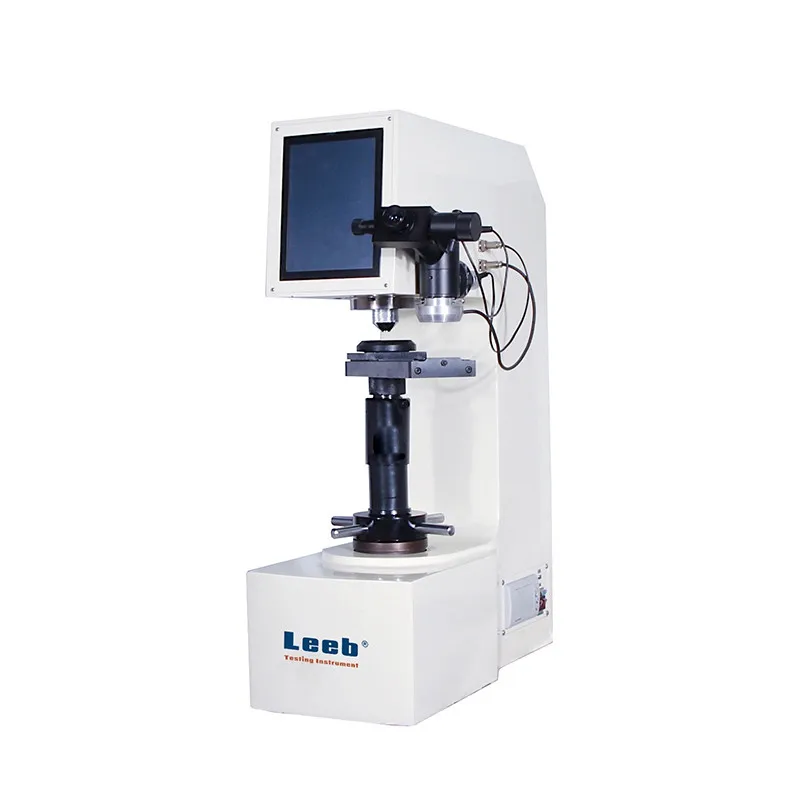
Our Digital Touch Screen Universal Hardness Tester is a great option if you want the flexibility to use different indenter shapes. It's easy to operate and can perform all the major hardness tests, so you can choose the right indenter for your specific testing needs.

Conclusion
In conclusion, the shape of the indenter plays a crucial role in the test results of a universal hardness tester. Each indenter shape - the Brinell ball, the Vickers pyramid, and the Rockwell cone or ball - has its own advantages and disadvantages, and is suitable for different types of materials and testing requirements.
If you're in the market for a universal hardness tester and need help choosing the right indenter shape for your application, don't hesitate to get in touch. We're here to assist you in making the best decision for your hardness testing needs. Whether it's for quality control in a manufacturing plant or research in a laboratory, we've got the expertise and the equipment to support you.
References
- ASTM International standards on hardness testing
- ISO standards related to hardness testing
- "Materials Science and Engineering: An Introduction" by William D. Callister Jr. and David G. Rethwisch